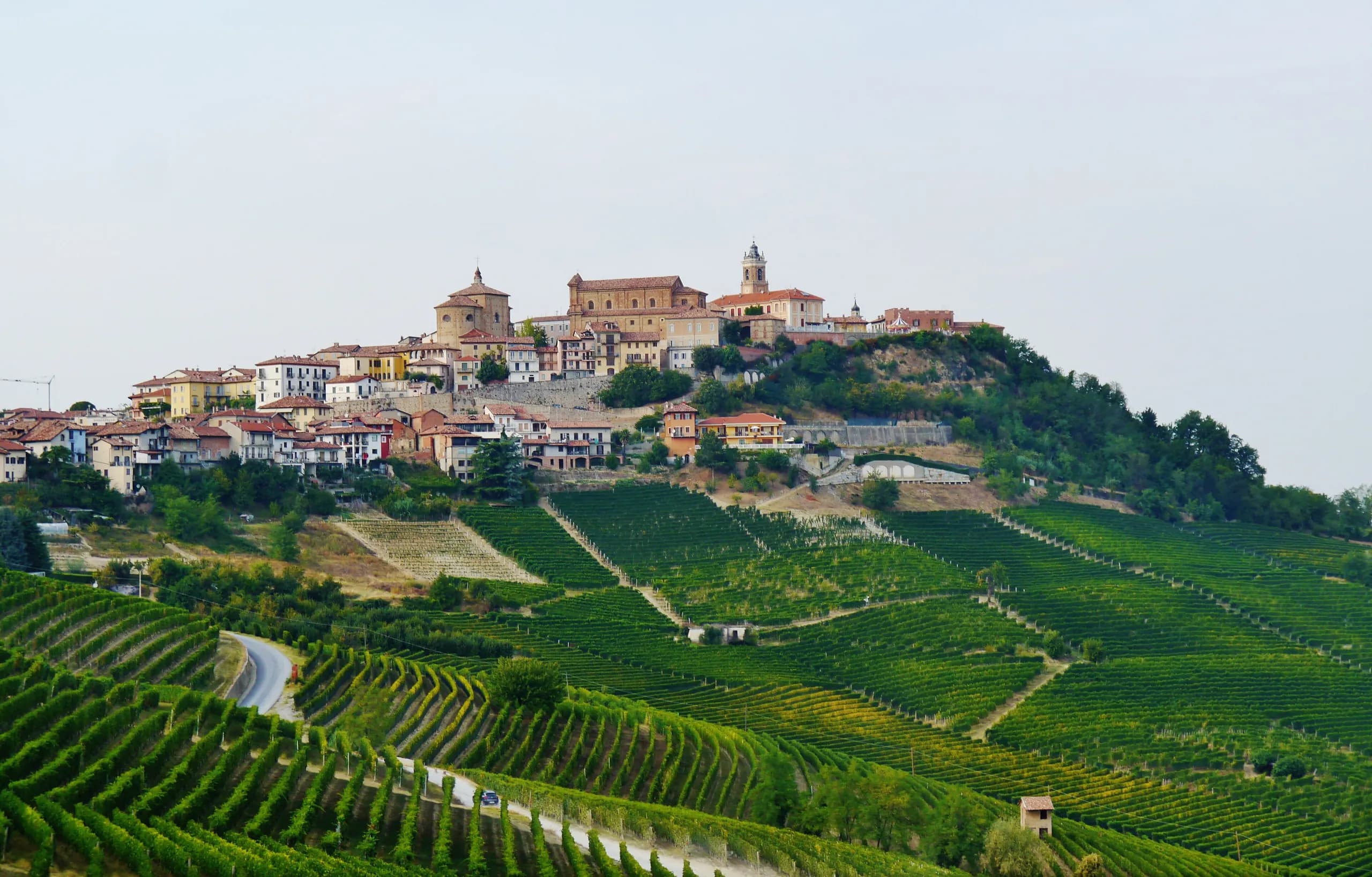
Langhe vs Tuscany
The Tuscany that hasn’t been discovered yet.
Rolling vineyards, hill towns and some of Italy’s best food, at roughly half the price per square metre. Here is how the two compare, figure by figure.
For decades, Tuscany was the default Italian dream. Today more and more buyers, many of them American, are looking a few hours north-west, to the hills of the Langhe & Monferrato.
At a glance
| Langhe (Piedmont) | Tuscany | |
|---|---|---|
| Average asking price, wine villages | €1,483 per m² (La Morra, Barolo, Monforte d’Alba, Neive) | €2,603 per m² (seven Chianti and Val d’Orcia villages) |
| Three-Michelin-star restaurants, 2026 | 2 in the Langhe alone | 1 in the whole region |
| Michelin-starred restaurants by province, 2026 | Cuneo: 14 | Florence: 12 · Siena: 12 · Lucca: 9 |
| Quality of Life 2025 (Il Sole 24 Ore, of 107) | Cuneo: 27th | Siena: 21st · Florence: 36th · Lucca: 58th |
| Cost of living | About €2,500 a month lives comfortably in a small village house (our experience on the ground) | Florence about 39% dearer than Cuneo, incl. rent (Numbeo, indicative) |
Property prices: about 43% less in Barolo country
Average asking prices in the core Barolo and Barbaresco villages are about 43% below those of Chianti and the Val d’Orcia. Even Alba, the busy capital of the Langhe, asks less per square metre than most Chianti villages. In the Monferrato the gap widens to about 66%.
Asking prices per square metre, wine villages, September 2026
| Town | € per m² |
|---|---|
| Monferrato | |
| Rocca GrimaldaAlto Monferrato | € 726 |
| OvadaAlto Monferrato | € 809 |
| Nizza MonferratoMonferrato | € 1,092 |
| Langhe | |
| NeiveBarbaresco hills | € 1,193 |
| Monforte d'AlbaBarolo hills | € 1,420 |
| La MorraBarolo hills | € 1,625 |
| BaroloBarolo hills | € 1,694 |
| AlbaCapital of the Langhe | € 2,345 |
| Tuscany: Chianti & Val d'Orcia | |
| MontalcinoVal d'Orcia | € 2,271 |
| Gaiole in ChiantiChianti | € 2,594 |
| Castellina in ChiantiChianti | € 2,642 |
| Greve in ChiantiChianti | € 2,784 |
| PienzaVal d'Orcia | € 2,818 |
| Radda in ChiantiChianti | € 2,972 |
Prices start lower than many buyers imagine: village houses that need renovation are listed from around €19,000. They need real work, so budget for it. Restored farmhouses typically run about €1,000–1,800 per m².
At the very top of the market the picture is similar: Engel & Völkers’ 2026 report puts prime country houses and villas in the Langhe, Roero and Monferrato at up to about €3,000 per m², and notes that international buyers, especially Americans, see the area as an alternative to Tuscany.
Food and wine: the Langhe leads
Two of Italy’s fifteen three-Michelin-star restaurants are in the Langhe: Piazza Duomo in Alba and La Rei Natura in Serralunga d’Alba. The whole of Tuscany has one: Enoteca Pinchiorri in Florence. At province level, Cuneo has 14 starred restaurants, more than Florence or Siena with 12 each.
Add Barolo and Barbaresco, the white truffle of Alba and the Slow Food movement, born in nearby Bra, and the Langhe has a fair claim to be Italy’s most serious food region.
Crowds and character
The Telegraph called the Langhe Italy’s “secret Tuscany”, villages that are never overrun with tourists. Forbes described it as one of the less touristed wine regions of Italy, and Condé Nast Traveller asked whether Piedmont is Italy’s best-kept secret. For a buyer, that means authentic village life, working wineries and neighbours who live here all year.
Everyday living
From our experience on the ground, in a small Langhe or Monferrato village, with a small house, you can live comfortably on about €2,500 a month. On Il Sole 24 Ore’s 2025 Quality of Life index, the province of Cuneo ranks 27th of 107, ahead of Florence (36th) and Lucca (58th), though behind Siena (21st). Indicative Numbeo data put living costs including rent about 39% higher in Florence than in Cuneo.
When Tuscany might suit you better
We would rather you choose well than choose us. If you want a Renaissance city on your doorstep, or summers on the Tuscan coast, Tuscany has strengths the Langhe cannot match. If you want great wine, food and landscape, real village life and more house for your money, the Langhe & Monferrato deserve a serious look.
Langhe or Tuscany: common questions
Why is property cheaper in the Langhe than in Tuscany?
Largely because Tuscany was discovered by international buyers much earlier. The Langhe’s reputation rests on wine and food, and only in recent years have foreign buyers, many from the US, begun looking here in numbers.
Is the Langhe the ‘new Tuscany’?
Several travel and property writers describe it that way; The Telegraph called it Italy’s ‘secret Tuscany’. We prefer to call it the Tuscany that hasn’t been discovered yet: similar beauty, its own character, and prices that still make sense.
Which is better for a vineyard property?
Both have great wine, but Barolo vineyard land is among the most valuable farmland in Italy, reported at up to about €2.3 million per hectare. For a house with vineyard views rather than a working estate, the Langhe and especially the Monferrato offer far more choice for the money.
See it for yourself
Come and walk the hills with us.
Biagio can plan a few days of viewings around the villages that match your budget and your idea of Italian life.
Plan a visit